
BIPM Digital SI and measurement units in CNML
2 min read · Concepts
BIPM Digital SI and measurement units in CNML
Legal-metrology certificates report measurement results, and every measurement result carries a unit. The authority for that unit traces to the International System of Units (SI), maintained by the Bureau International des Poids et Mesures (BIPM). The BIPM Digital SI framework brings the SI into a machine-readable form that CNML consumes directly. Every unit that appears in a CNML certificate traces through an unbroken authority chain to the SI definition.
Why the SI matters for legal metrology
A load-cell characteristic expressed in kilonewtons, a temperature in degrees Celsius, and a pressure in pascals all derive their authority from the SI. When the SI definition is available in a digital form, downstream systems can verify that a unit identifier refers to the intended quantity and can perform unit conversions with provenance.
The BIPM Digital SI initiative is the programme through which BIPM is rendering the SI in a form suitable for machine consumption. The initiative addresses the need for authoritative, machine-readable unit definitions that measurement systems, calibration pipelines, and conformity-assessment infrastructure can reference without ambiguity.
How CNML references units
CNML embeds unit identifiers directly in the XML certificate. Each characteristic carries a unit identifier and, where needed, an inline structured unit fragment. The identifier resolves to the authoritative SI definition via the BIPM Digital SI framework.
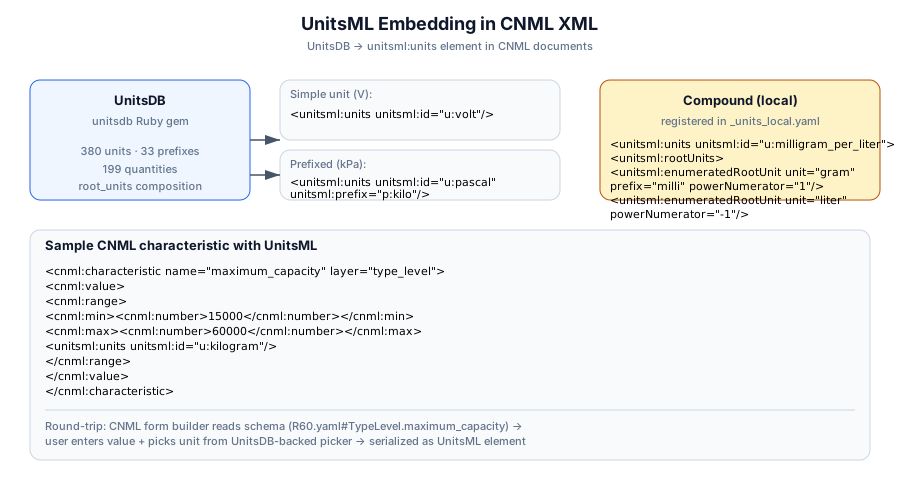
This design means a measurement result in a CNML certificate is not an isolated number with an opaque unit string. The unit is resolvable. A downstream system that receives a CNML certificate can follow the identifier to the authoritative SI definition and confirm that the unit means what the certificate says it means.
Why this matters for legal metrology
Legal-metrology certificates are consumed by systems that did not produce them and that may operate in different regulatory and technical contexts. A market-surveillance authority verifying an instrument in one jurisdiction may need to interpret a certificate issued in another. A calibration laboratory consuming a CNML test report as evidence in a subsequent calibration needs to convert units with confidence. The authority chain through the BIPM Digital SI framework makes this possible without ad-hoc unit parsing.
See also
- System architecture describes the certificate model and the per-Recommendation schema structure.
- FAIR principles and D-CoC develops the FAIR alignment that benefits from unit traceability.