Skip to content
CNMLCertificat Numérique de Métrologie Légale

OIML SMART programme · 2026 edition (proposal)

Verifiable type approvals
and signed measurements
for legal metrology

A certificate format where every type approval is issued under a distributed threshold signature, recorded in a public transparency log anchored to Bitcoin, and verifiable offline by any party with a web browser. The chain extends from the OIML root through issuing authorities and manufacturers to the individual instrument, whose signed measurements are independently timestamped and traceable to their calibration state.

X.509 v3 · XMLDSig·FIPS 204 · RFC 6962·22 OIML Recommendations
1 5/7 OIML / BIML Root threshold quorum - delegates signing 2 Issuing Authority scoped to Recommendations 3 Test Lab signs reports 3 Manufacturer Model delegated signing key 4 Instance Certificate serial - firmware - calibration 5 Signed Measurements value - timestamp - conditions - signature OTS Cert'd Tester T1 ROOT T2 IA T3 MODEL T4 DEVICE T5 MEASURE
§ 01CapabilitiesFour properties

What CNML provides

CNML was designed for the specific requirements of legal-metrology type approval. Four cryptographic properties distinguish it from web PKI and from single-key document signing. Each property is a structural guarantee, not a policy agreement.

01FROST · CMP20

Distributed signing authority

No single party can produce a CNML certificate at the root or Issuing Authority tier. Signing authority is distributed across an international threshold quorum of directors and officers using FROST threshold signatures. A court order directed at one officer cannot complete a signature, and theft of one key holder's hardware cannot forge a certificate. The aggregate public key survives director rotation, so all previously issued certificates remain valid without re-issuance.
02XMLDSig · W3C

Cryptographic verification

Any party can verify a CNML certificate in a web browser, offline, without contacting the issuer, registering for a service, or holding an account. The verifier downloads a trust-anchor bundle once and can then verify certificates indefinitely. The verification pipeline checks XML structure, schema conformance, signature validity, issuer scope, revocation status, timestamp proof, and transparency-log inclusion.

03FIPS 204 · ML-DSA

Post-quantum security

CNML ships composite signatures combining Ed25519 (classical, RFC 8032) with ML-DSA-65 (post-quantum, NIST FIPS 204). A composite signature is valid only when both components verify. An attacker must break both algorithms to forge a signature. Documents signed today remain secure through the transition to quantum computing.

04RFC 6962 · OTS

Public transparency

Every issued certificate appears in a public Merkle transparency log. Tree roots are anchored to Bitcoin through OpenTimestamps. No certificate can be silently issued or retroactively inserted. The log is mirrored across independent operators, and gossip protocols prevent equivocation. A verifier that demands an inclusion proof rejects any certificate that did not appear in the log.

§ 02Audience pathsSix audiences

Who CNML is for

The certificate format touches every role in legal metrology. Each audience page describes the current workflow, the change CNML introduces, the operational detail, and the next step.

§ 03How it worksVisual overview

The trust chain

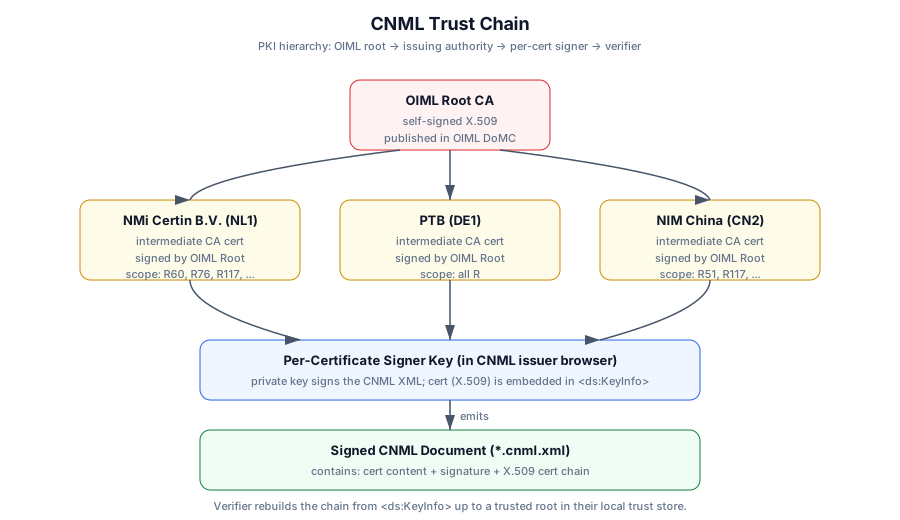
Authority flows from the OIML root through Issuing Authorities down to the individual instrument. Each tier is cryptographically bound to the next. No single party can forge a certificate.

CNML trust chain: OIML root cert to issuing authority to per-cert signer to user verification

Signing a certificate

The IA officer's key signs the CNML XML using threshold cryptography. Multiple officers must participate; no single key can complete the signature.

CNML signing flow: threshold ceremony produces a signed certificate

Verifying a certificate

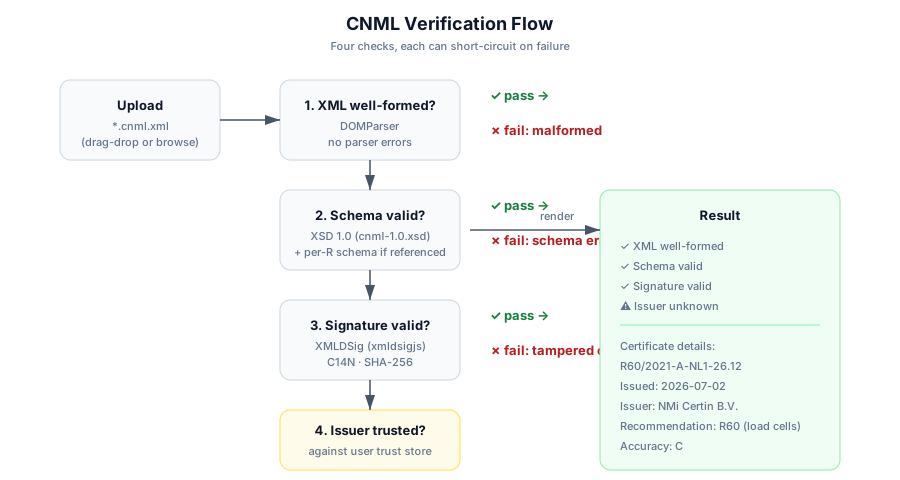
Anyone can verify a CNML certificate in a browser, offline. The seven-check pipeline validates XML structure, schema, signature, scope, revocation, timestamp, and transparency.

CNML verification flow: seven-check pipeline from XML parse to transparency log inclusion
§ 04TechnologyStandards stack

What CNML is built on

CNML builds on established international standards. The certificate chain follows X.509 v3 with a custom scope extension that binds each Issuing Authority to a specific subset of OIML Recommendations. Signatures use W3C XMLDSig with RFC 8784 Exclusive Canonicalization, produced as composite Ed25519 plus ML-DSA-65 per NIST FIPS 204. Transparency is provided by a Merkle log per RFC 6962 Certificate Transparency, with tree roots anchored to Bitcoin through OpenTimestamps. The full treatment of each standard, including the algorithm choices and the hardware tiers, appears on the technology page.

Read the technology page
§ 05Try itIn the browser

Generate and verify CNML certificates in the browser

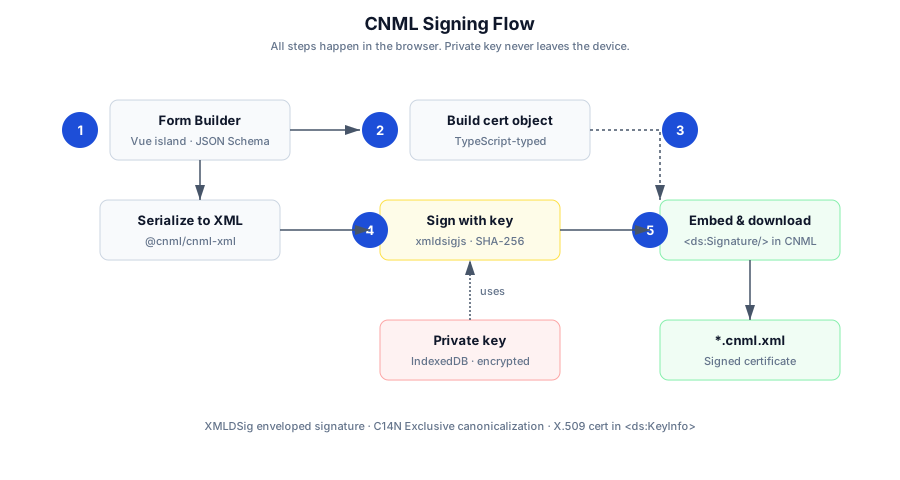
The interactive tools generate sample CNML certificates for evaluation purposes. They run entirely in the browser. Private keys are generated on device, encrypted with a passphrase-derived key, and never leave the machine. The three issuing scenarios exercise the real threshold-signing coordinator, and the verifier runs the full nine-check pipeline against any CNML file.

Open the certificate operations app